
ICLR 2026
ParallelBench: Understanding the Trade-offs of Parallel Decoding in Diffusion LLMs
1FuriosaAI 2UW-Madison 3Microsoft Research 4UC Berkeley 5Seoul National University 6KRAFTON 7Ludo Robotics *Equal Contribution
Abstract
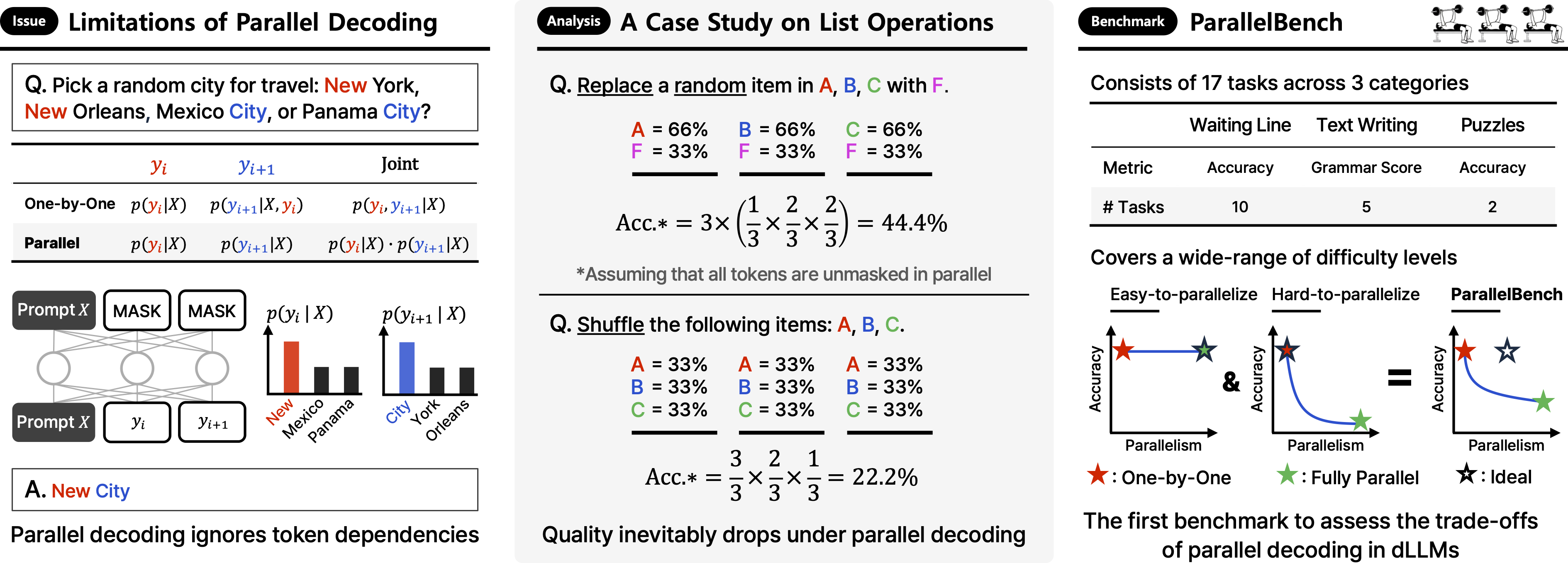
While most autoregressive LLMs are constrained to one-by-one decoding, diffusion LLMs (dLLMs) have attracted growing interest for their potential to dramatically accelerate inference through parallel decoding. Despite this promise, the conditional independence assumption in dLLMs causes parallel decoding to ignore token dependencies, inevitably degrading generation quality when these dependencies are strong. However, existing works largely overlook these inherent challenges, and evaluations on standard benchmarks (e.g., math and coding) are not sufficient to capture the quality degradation caused by parallel decoding.
To address this gap, we first provide an information-theoretic analysis of parallel decoding. We then conduct case studies on analytically tractable synthetic list operations from both data distribution and decoding strategy perspectives, offering quantitative insights that highlight the fundamental limitations of parallel decoding. Building on these insights, we propose ParallelBench, the first benchmark specifically designed for dLLMs, featuring realistic tasks that are trivial for humans and autoregressive LLMs yet exceptionally challenging for dLLMs under parallel decoding.
Using ParallelBench, we systematically analyze both dLLMs and autoregressive LLMs, revealing that: (i) dLLMs under parallel decoding can suffer dramatic quality degradation in real-world scenarios, and (ii) current parallel decoding strategies struggle to adapt their degree of parallelism based on task difficulty, thus failing to achieve meaningful speedup without compromising quality. Our findings underscore the pressing need for innovative decoding methods that can overcome the current speed-quality trade-off. We are releasing our benchmark to help accelerate the development of truly efficient dLLMs.
Why ParallelBench?
Parallel decoding is fast, but not free. Under conditional independence assumption, parallel decoding ignores dependencies, resulting in a drop in quality when tokens depend on each other. We provide information-theoretic analysis and quantitatively evaluate this trade-off using synthetic tasks.
Information-Theoretic Analysis
Proves that parallel decoding has fundamental error bounds when tokens depend on each other, showing even ideal models suffer as we increase parallelism on tasks requiring strong token coordination.
Quantitative Case Studies
Analytically tractable synthetic list operations (Copy, Replace, Shuffle) with closed-form accuracy formulas demonstrate fundamental limitations: specific tasks show inevitable quality degradation under parallel decoding.
Realistic Benchmark Tasks
17 tasks across Waiting Line, Text Writing, and Puzzles—all trivial for humans and AR LLMs—reveal severe quality degradation in dLLMs under parallel decoding in real-world scenarios.
Benchmark Overview
ParallelBench consists of 17 tasks across 3 categories. Each task exposes different aspects of the speed-quality trade-off in dLLMs.
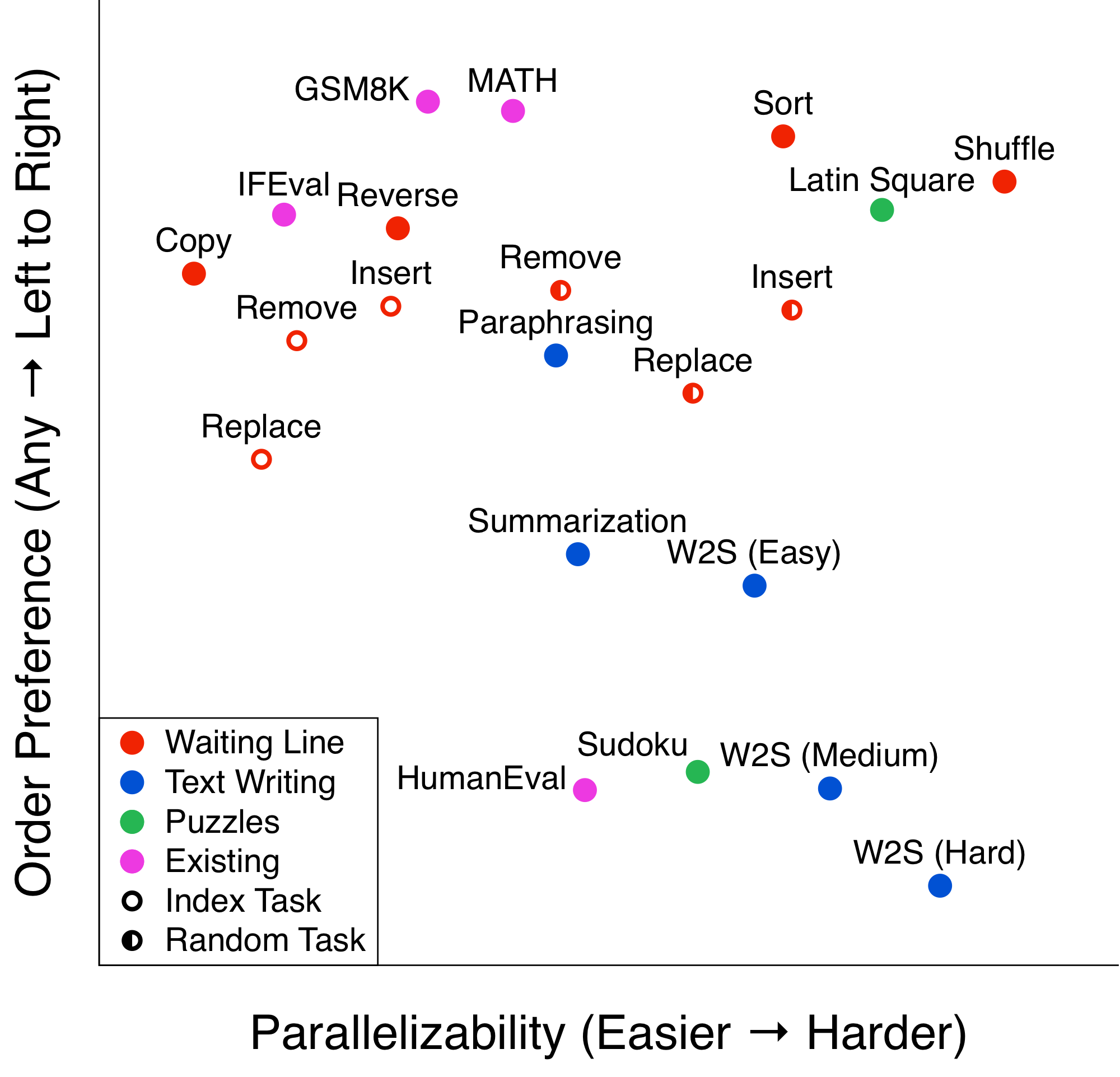
Waiting Line is a set of list operations (e.g., shuffle, replace) manipulating realistic customer service scenarios. The number of customers n serves as a controlled variable for adjusting difficulty.
Shuffle
You are managing a waiting line at a customer service desk.
The waiting line should be randomly shuffled to ensure fair service distribution:

["Paul Payne", "Robert Riley", "Peter Stone"]

Please randomly shuffle the list and provide only the final list.
Ensure the sequence is different from the original.
More examples
Replace Index
You are managing a waiting line at a customer service desk.
The person at position 0 must be replaced with "Henry Warren":

["Patrick Morgan", "Eric King", "Joe Reed"]

Please replace the person at the specified position with "Henry Warren" and provide only the final list.
Replace Random
You are managing a waiting line at a customer service desk.
One person in the waiting line must be replaced with "Juan Torres":

["David Owens", "Kelly Payne", "Aaron Freeman"]

Please replace one random person with "Juan Torres" and provide only the final list.
Text Writing consists of five text generation tasks: summarization, paraphrasing, words-to-sentence generation. We introduce a Grammar Score metric that imposes stronger token-level dependencies.
Summary
Summarize the following conversation. Only output the final result.

Steve: Bought the new Dream Theater album 5 minutes ago. I hope it's good.
Rob: I have it here on my desk, ready for the first listening.
Steve: Ok, I'll tell you later what I think about it.
Rob: Same here. See you later!

Summary:
More examples
Paraphrase
Paraphrase the following sentence. Only output the final result.

Sentence: Any idea of what sweater this is?

Paraphrase:
Words-to-Sentence (easy)
Construct a single, coherent sentence using the words dog, park, ball, and throw.
Words-to-Sentence (hard)
Construct a single, coherent sentence using the words algorithm, river, symphony, and moss.
Puzzles consists of two classic puzzle tasks: Sudoku, which has a unique solution, and Latin Square, which has multiple valid solutions. This difference in solution space affects parallel decoding differently based on conditional total correlation C(Y|X).
Sudoku
Fill the positions where the values are 0 in a 4x4 grid with digits 1-4 so that each column, each row, and each of the four 2x2 subgrids that compose the grid contains all of the digits from 1 to 4.

Input:
0042
2031
4023
3214
Output:
More examples
Latin Square
Generate a Latin square of size 4 with the symbols [H, 4, C, A]. Only output the final result as CSV.
Results on ParallelBench
Evaluation of LLaDA 1.5 across tasks reveals systematic quality degradation as parallelism increases.
Waiting Line
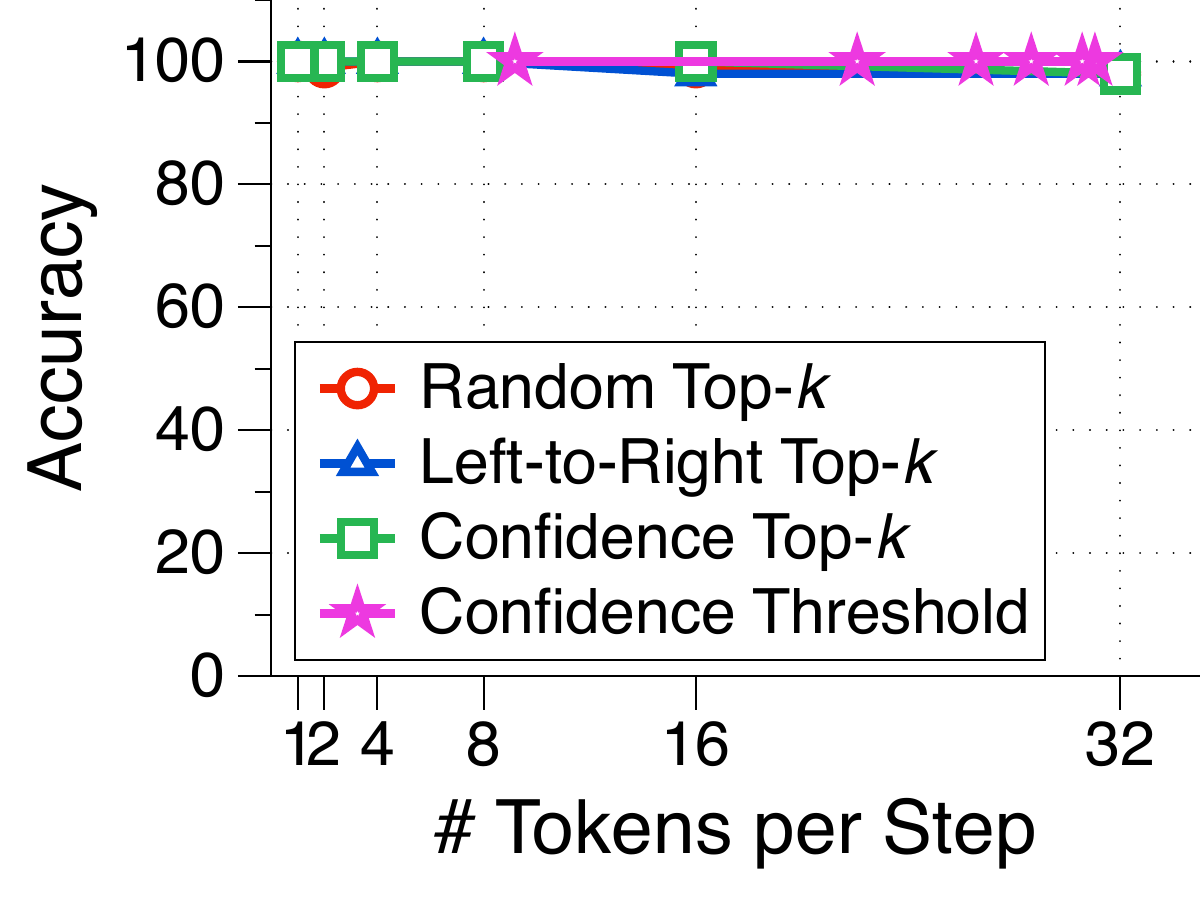
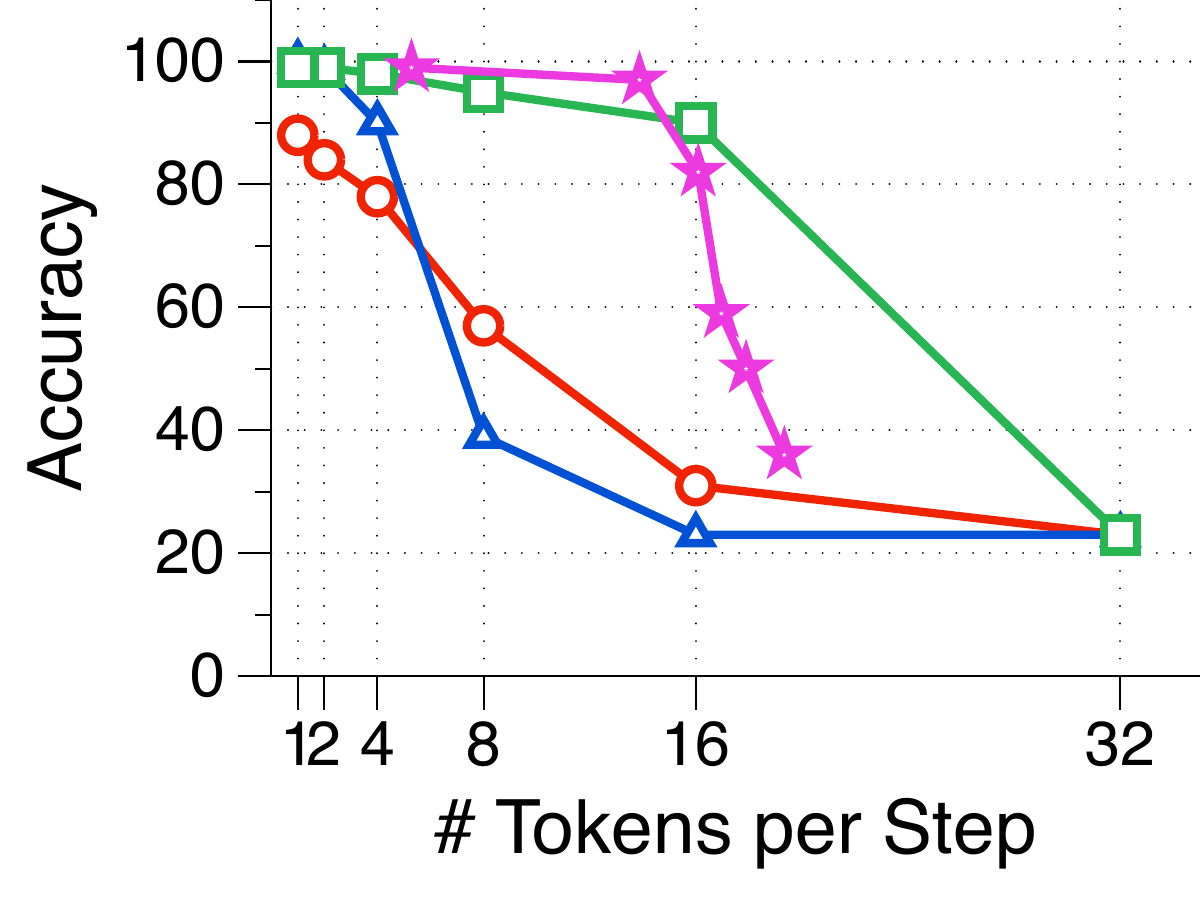
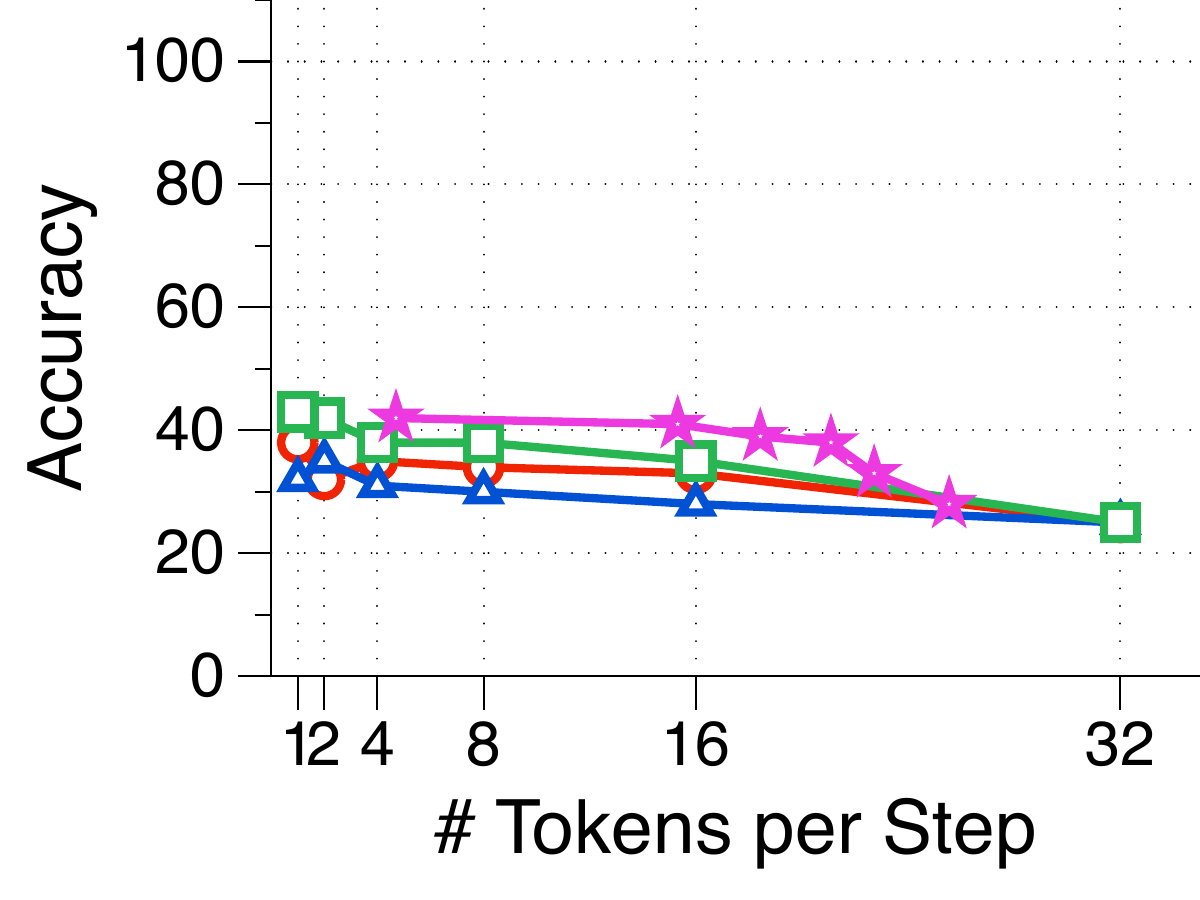
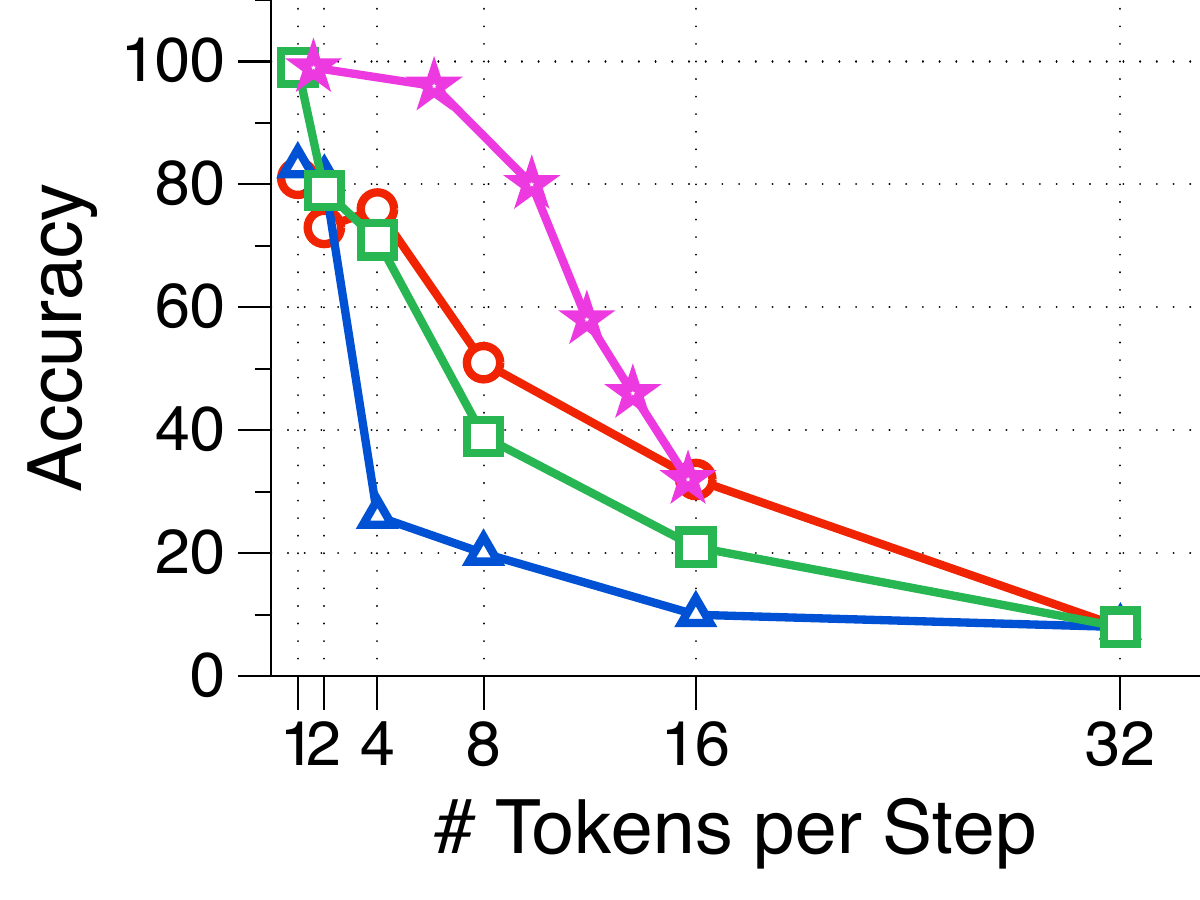
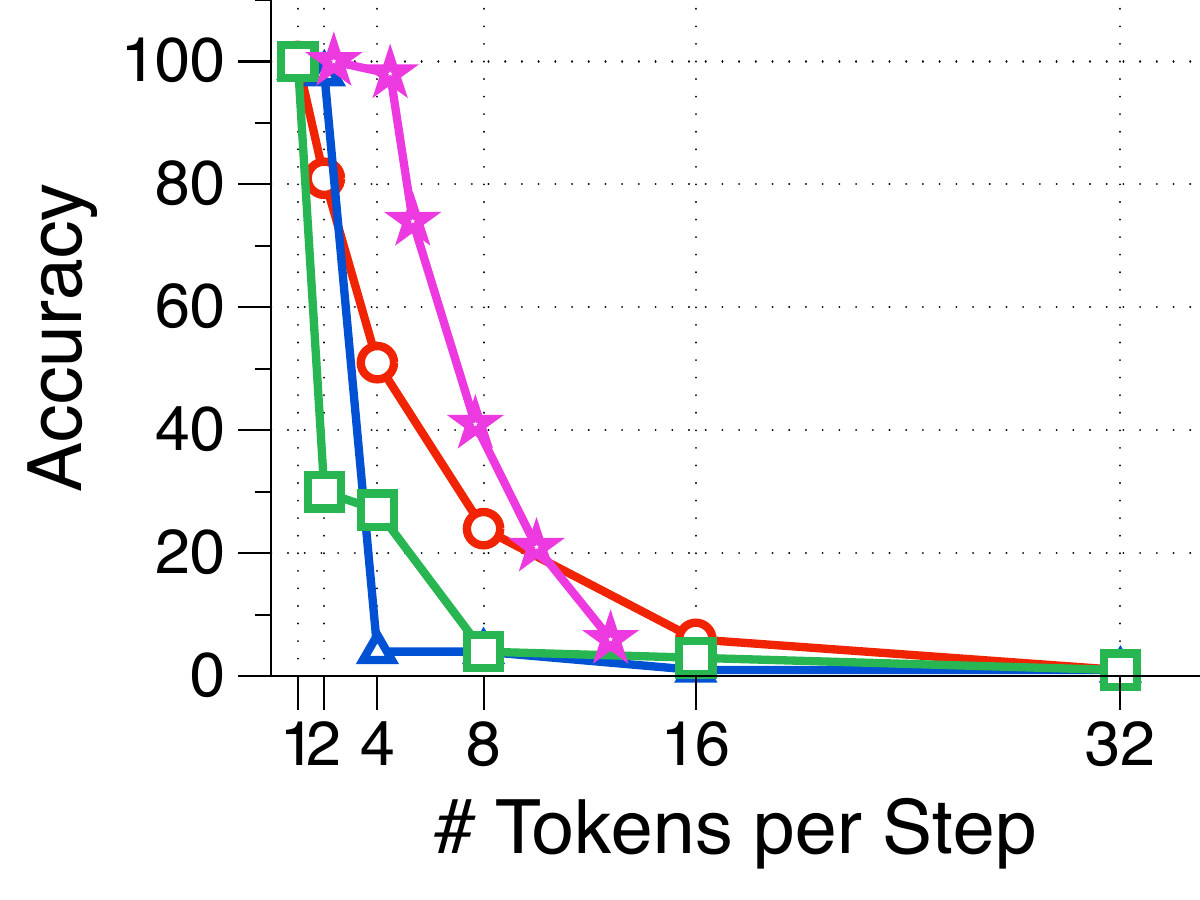
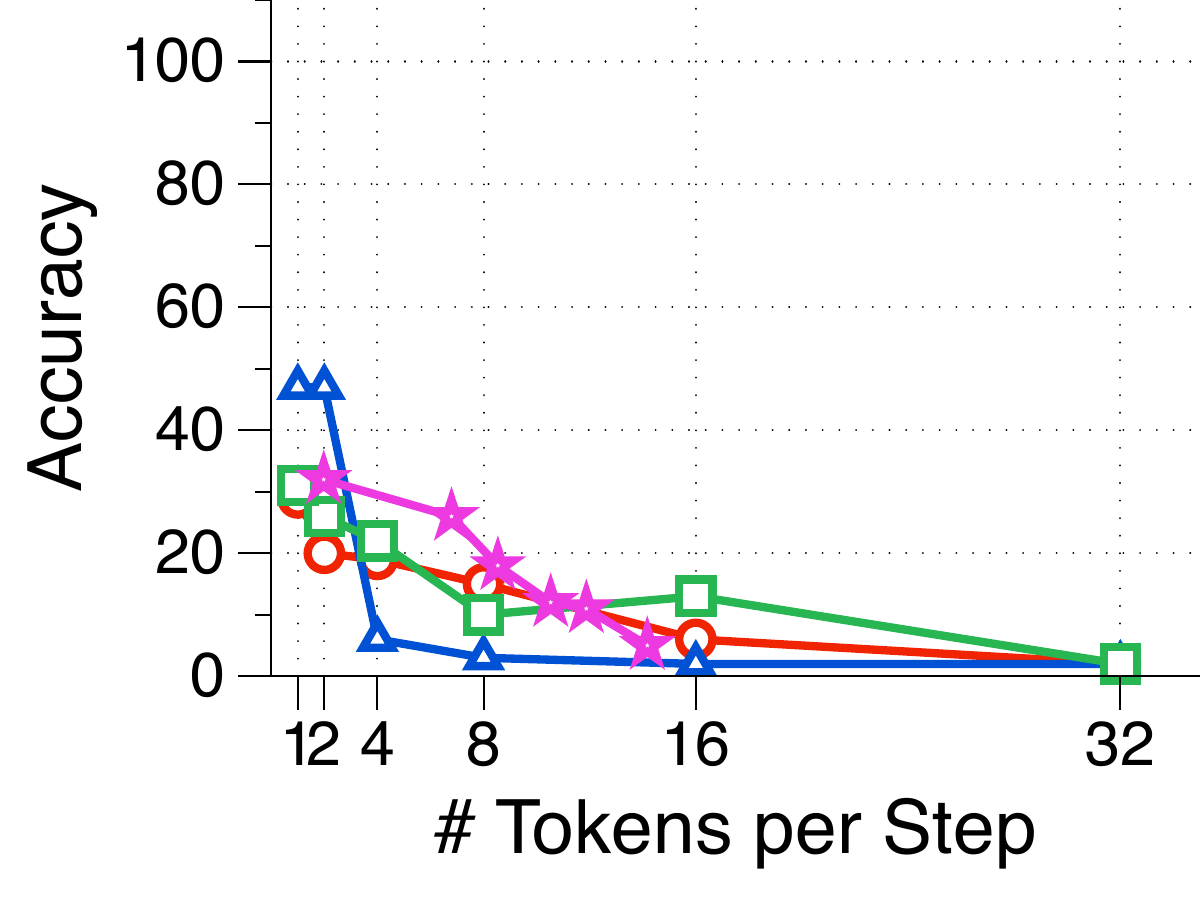
Replace Index and Replace Random exhibit contrasting trends. Despite Replace Random achieving near-perfect one-by-one decoding accuracy compared to Replace Index's below 50% accuracy, this advantage reverses under parallelization. This aligns with our theory: C(Y|X)=0 for Replace Index but C(Y|X)>0 for Replace Random.
Text Writing
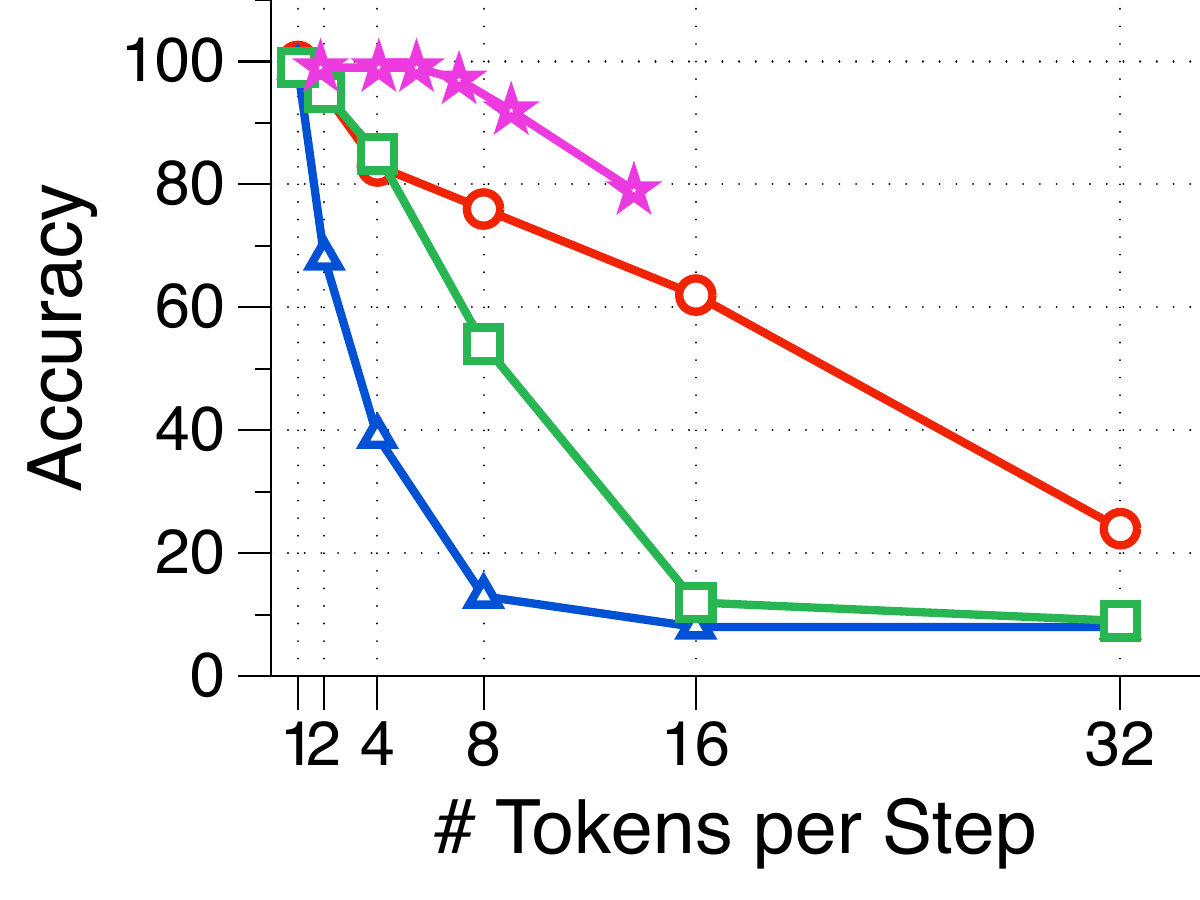
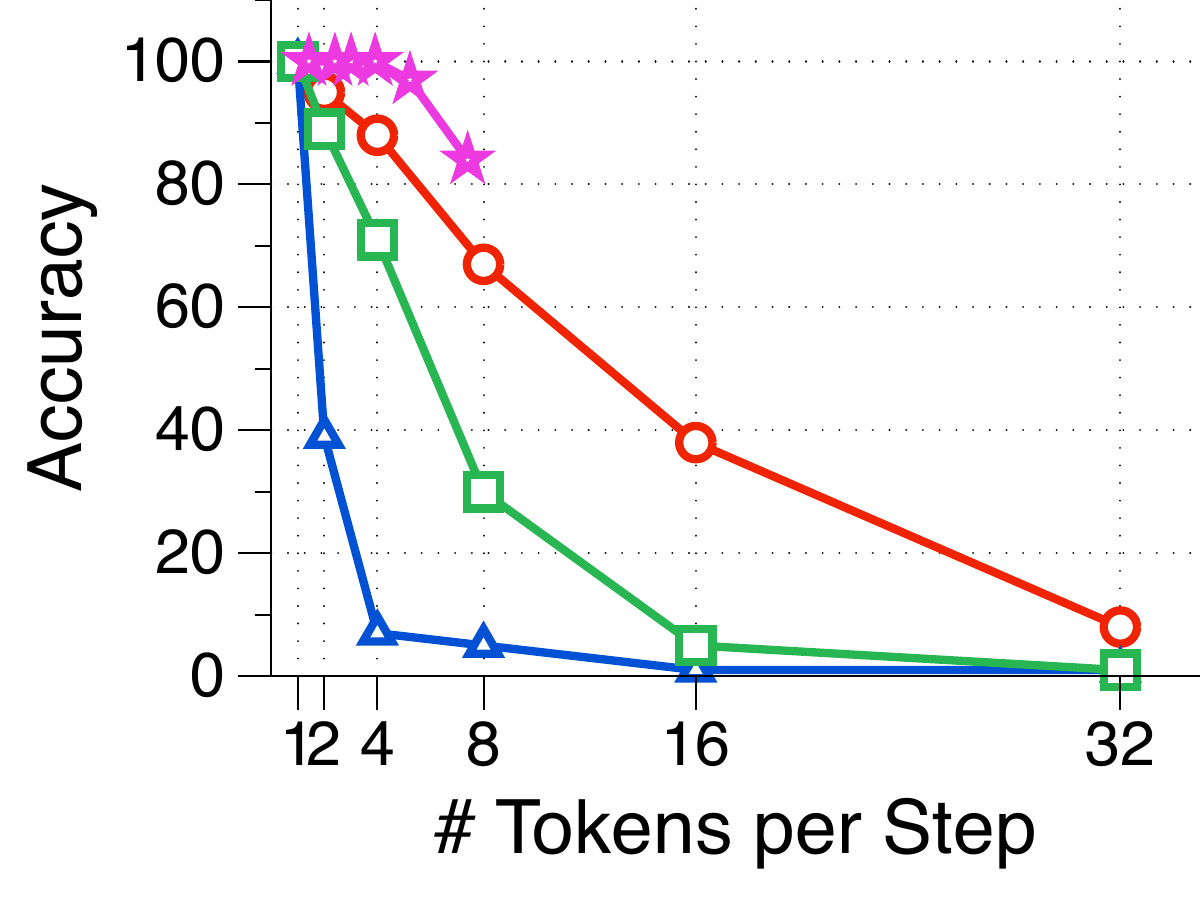
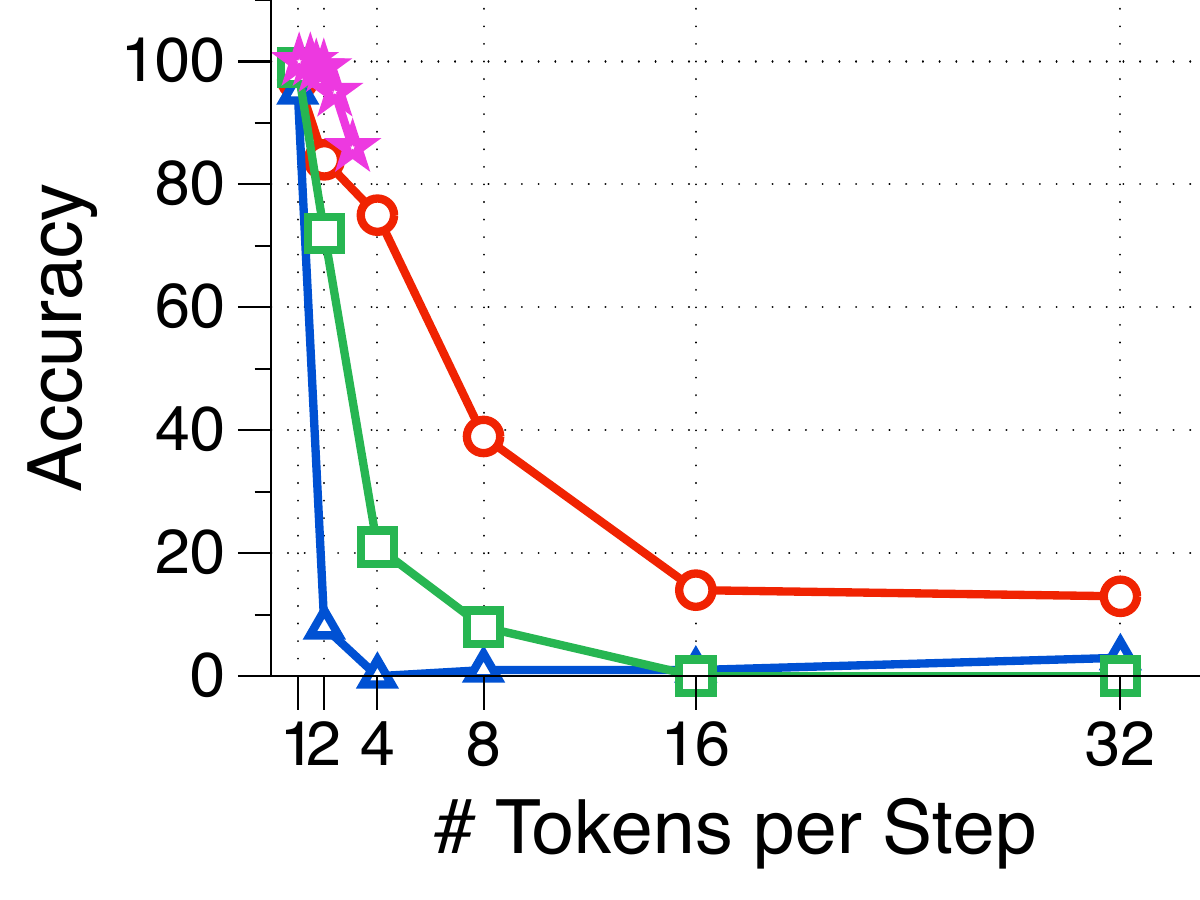
Puzzles
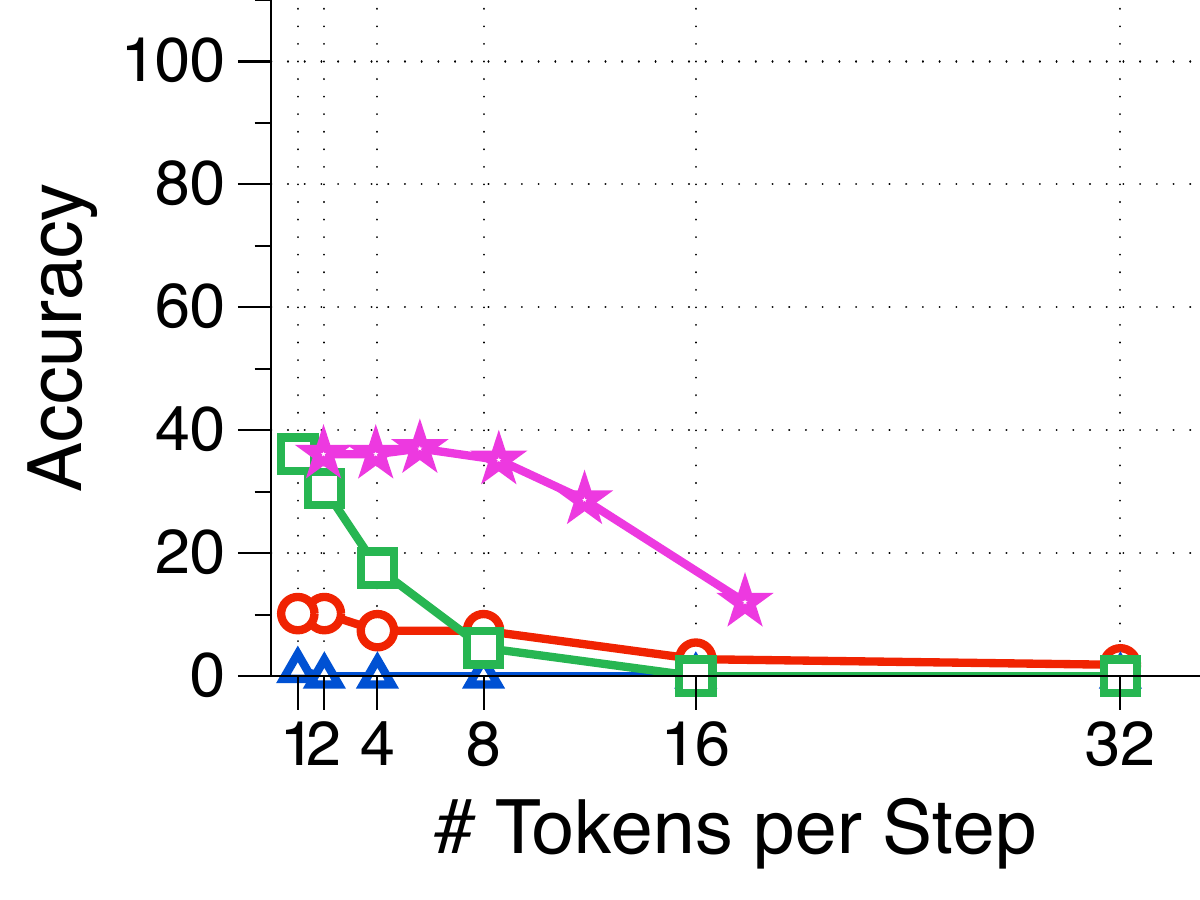
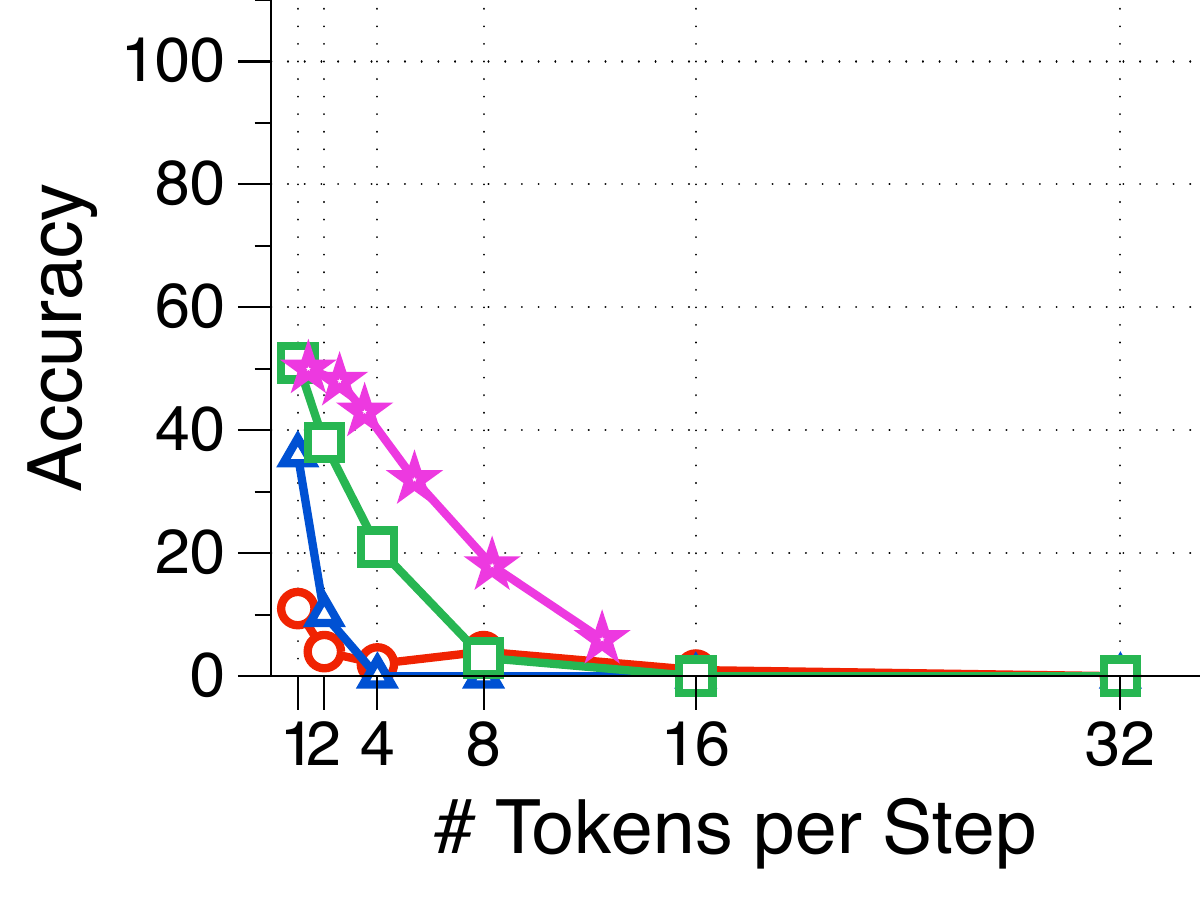
Latin Square outperforms the harder Sudoku under one-by-one decoding, but this advantage disappears with increased parallelism. This reflects the difference in conditional total correlation: C(Y|X)>0 for Latin Square, while C(Y|X)=0 for Sudoku.
Cross-Model Comparison
The speed-quality trade-off is not unique to LLaDA.
Closed-source dLLM Mercury and autoregressive LLMs show contrasting behaviors.
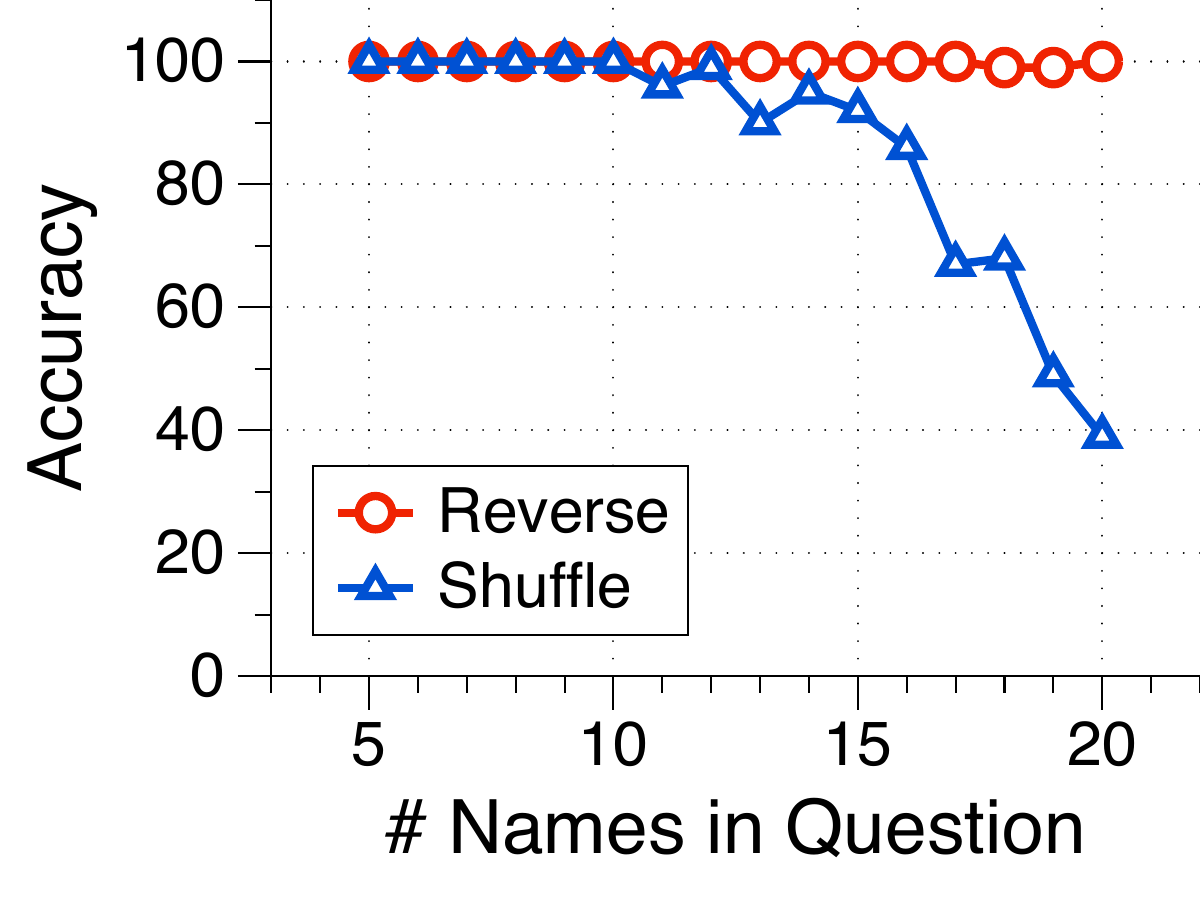
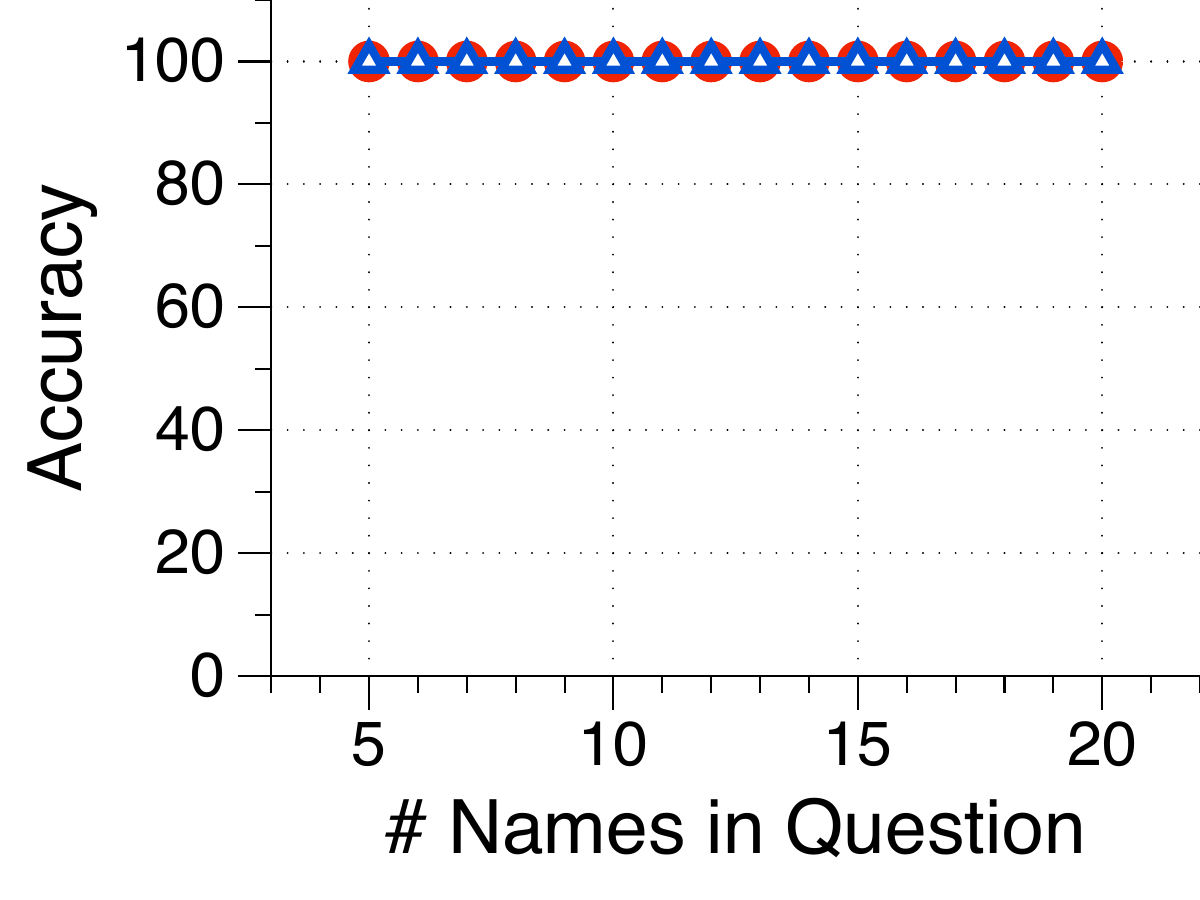
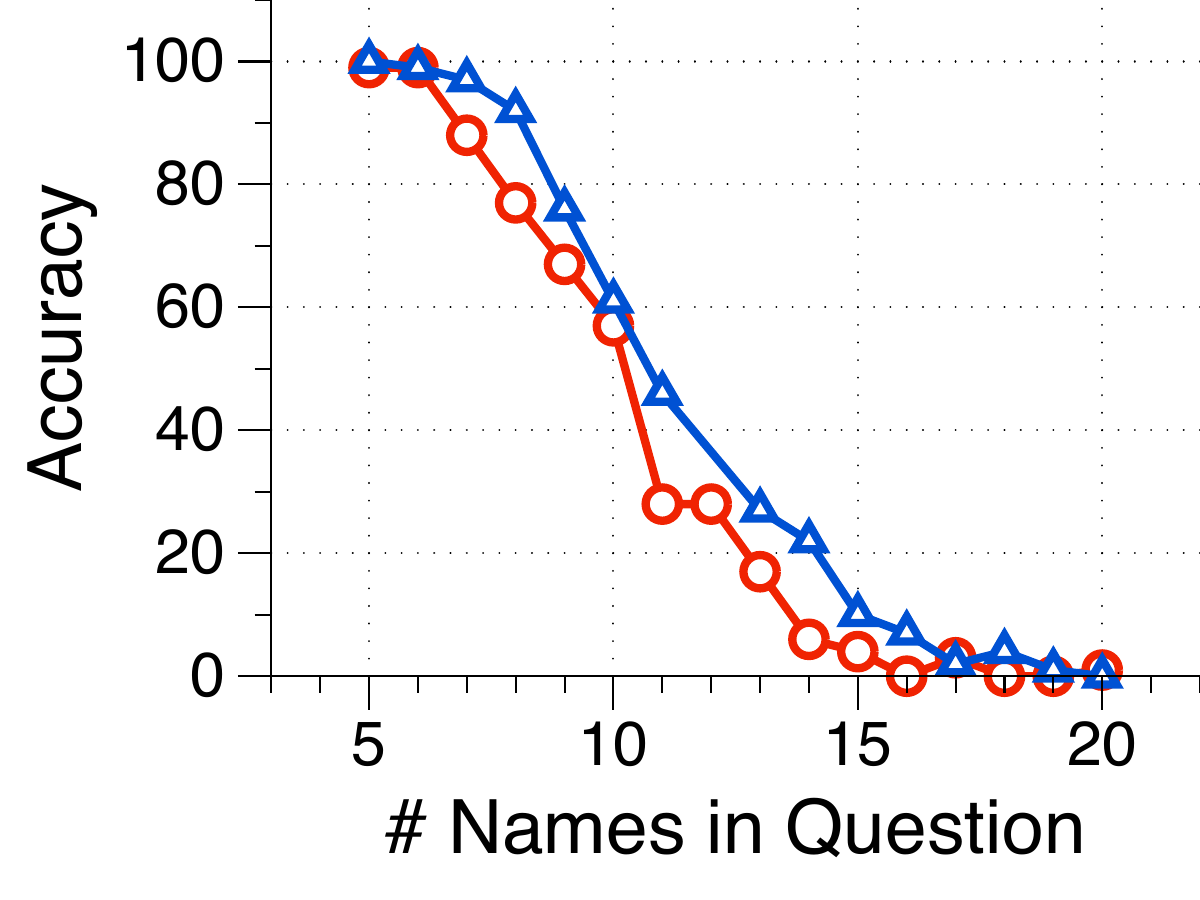
Mercury and autoregressive LLMs show opposite accuracy trends on Reverse and Shuffle. Mercury maintains near-perfect accuracy on Reverse but fails with Shuffle, with accuracy dropping sharply as n increases. This indicates that the closed-source Mercury struggles to adaptively adjust its parallelism to maintain quality on tasks with high token dependencies.
The Speed-Quality Trade-off
Current parallel decoding strategies are far from optimal. Oracle performance shows where they fall short.
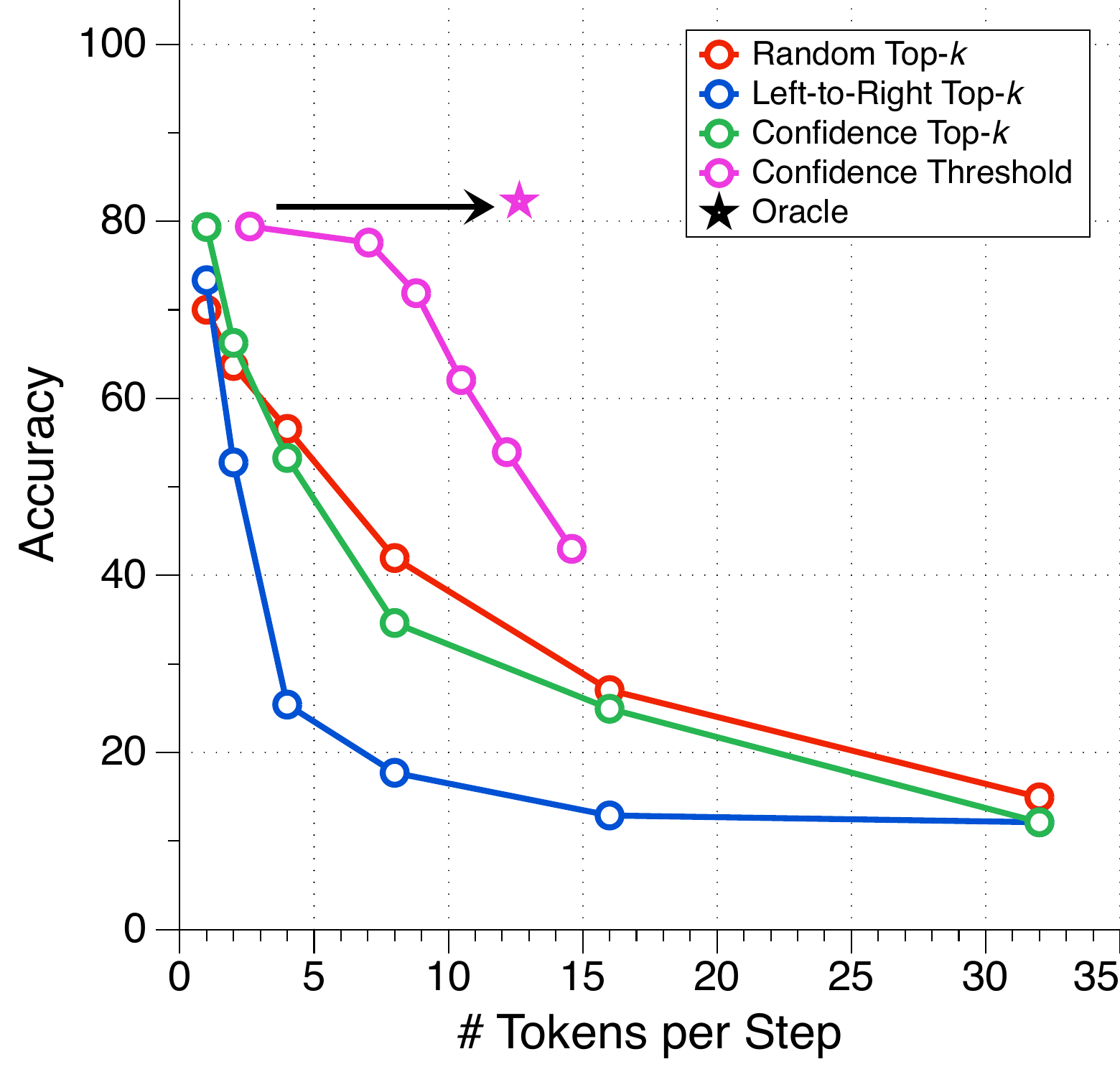
The oracle achieves both the best accuracy and a significant speedup over threshold methods with comparable accuracy, demonstrating that per-sample threshold adaptation alone yields significant improvements and suggests a substantial room for future research.
Leaderboard
Compare the speed and accuracy of parallel decoding strategies across diffusion LLMs on ParallelBench.
Interactive
Max TPS at an accuracy threshold
The leaderboard shows the maximum TPS (Tokens Per Step) achieved by each method while maintaining at least a chosen accuracy. The chart visualizes accuracy vs. TPS trade-offs for each unmasking method.
- Models
- LLaDA 1.5, LLaDA 8B Instruct, Dream 7B, DiffuCoder
- Unmasking methods
- Random, Left-to-Right, Confidence Threshold, Confidence Top-K, Confidence Factor, Entropy Top-K, Top-K Margin, KLASS, SlowFast Sampling, DUS, WINO-DLLM
- Metric
- TPS (Tokens Per Step): the number of tokens decoded in a single denoising step.
- Code
- furiosa-ai/ParallelBench
BibTeX
@article{kang2025parallelbench,
  title   = {ParallelBench: Understanding the Trade-offs of Parallel Decoding in Diffusion LLMs},
  author  = {Kang, Wonjun and Galim, Kevin and Oh, Seunghyuk and Lee, Minjae and Zeng, Yuchen and Zhang, Shuibai and Hooper, Coleman and Hu, Yuezhou and Koo, Hyung Il and Cho, Nam Ik and others},
  journal = {arXiv preprint arXiv:2510.04767},
  year    = {2025}
}